
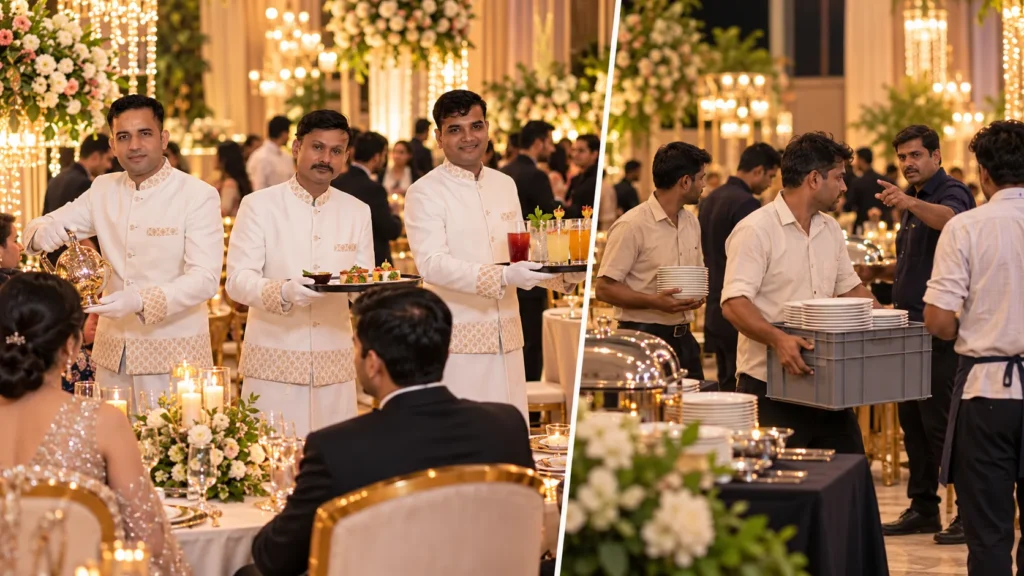
Why Trained Event Manpower Is Different From Temporary Workers
It’s 8:15 on a reception evening. The lawns are lit, the florals are exactly what the bride’s mother wanted, and the first cars are pulling in. On paper, staffing is sorted: twenty-two people in black waistcoats are on the floor.
Twenty minutes later, the groom’s uncle is asking who is looking after the family table. A guest near the stage has been holding an empty glass for ten minutes. The live pasta counter has a queue curling around a pillar. And three staff members are standing by the service entrance, trays in hand, waiting to be told what to do.
Nobody is lazy. Nobody is rude. So what went wrong?
The event had enough people. What it lacked was clarity about what each of them was there to do. That gap between headcount and capability is what separates trained event manpower from staff hired simply to fill numbers.
“We Need 20 People” Is Not a Staffing Plan
Most staffing conversations start with a number. The number matters, but the useful questions come after it:
- What will those 20 people actually do?
- Have they been briefed on this venue and these guests?
- Do they understand guest etiquette?
- Who clears tables? Who serves the VIP lounge?
- Who handles requests from the hosts?
- Who reports problems, and to whom?
- What happens when the schedule changes?
If nobody can answer these, the number on the quotation doesn’t tell you much. The value of event manpower is decided by what the staff can consistently do, not just by how many of them show up.
“Temporary” Doesn’t Automatically Mean “Bad”
This needs saying upfront. Temporary event workers are a normal, useful part of event operations. They make sense for setup and dismantling, loading and moving supplies, back-of-house support, and short, high-volume tasks where specialist hospitality skills simply aren’t needed.
Many temporary workers are hardworking, quick to learn and experienced. Employment status says nothing about anyone’s worth.
The trouble starts when an event quietly expects someone hired for headcount to perform a role that depends on etiquette, discretion, timing and professional communication. That isn’t a failure of the person. It’s a mismatch between the role and the preparation behind it.
So the better question isn’t “temporary or permanent?” It’s “What level of preparation does this event actually need?”
The First Difference: They Know Their Role
“Here are your instructions” is not the same as “Here is your role, your service area, your responsibilities and who you go to if something goes wrong.”
In a well-planned hospitality team:
- A waiter handles table service, beverages, clearing and guest assistance within a defined section.
- A steward manages buffet and table support, replenishment and guest-facing duties at specific stations.
- A supervisor coordinates the team, watches service zones, shifts people where demand builds and handles escalations.
Trained waiters and trained stewards arrive understanding these distinctions. When roles are clear, staff don’t drift toward the busiest-looking spot or cluster near the kitchen. Role clarity doesn’t make people robotic. It frees them to watch guests instead of guessing what to do next.
Training Shows Up in Small Moments
Guests never see the training session. They see its results.
A waiter waits for a pause in conversation before offering the next round. An empty glass disappears without the table noticing. A spilt drink is handled with a napkin, a quiet word and a fresh glass, not a flurry of apologies that turns every head. A request from the bride’s father goes discreetly to the right person instead of being shouted across the lawn. A staff member recognises when something is beyond their role and calls a supervisor before the guest is left waiting. Trays are carried steadily, and nobody stands at an empty counter wondering if more food is coming.
None of these moments is dramatic. Together, they are most of what guests remember about service. Training becomes visible through behaviour.
Grooming Is Not Just About Looking Good
In event hospitality, grooming is part of the job. It means clean, well-fitted, consistent uniforms, personal hygiene, neat hair, appropriate polished footwear, and a team that looks like one team.
Guests read appearance as a signal of organisation. When one steward has a creased shirt, another is in sports shoes and a third has a stained apron, even a beautifully planned event starts to feel less coordinated.
None of this is about how anyone naturally looks. It’s about cleanliness, consistency and respect for the occasion, and around food, hygiene is non-negotiable.
Guest Interaction Is a Skill
Serving food and interacting with guests are related but different skills. Good interaction involves tone, listening, appropriate eye contact, respectful language, personal space, and knowing when to approach and when to step back.
Take a simple question: “Where is the dining area?”
The unprepared answer is a quick point: “Over there.”
A prepared staff member reads the situation. An elderly guest with a walking stick, on an uneven farmhouse lawn at night, shouldn’t be pointed toward a distant tent. Better to walk with her, mention the step at the entrance and perhaps find her a seat near the family. Guests should be guided, not dismissed.
The same applies to harder moments: a guest annoyed about a wait, a relative insisting on a dish that has run out, a corporate attendee who’s had one drink too many. Staying calm, polite and firm is a learned skill.
Trained Staff Understand Timing
Good service is less about speed than about doing the right thing at the right moment.
- Offering drinks once guests have settled, not mid-greeting
- Clearing plates when the whole table has finished
- Never interrupting a toast, a speech or the varmala
- Replenishing a buffet tray before it empties, not after a queue forms
- Staying visible enough to be found, without hovering
- Calling a supervisor early, before a small problem becomes a visible one
A waiter who clears plates mid-conversation is efficient on paper and disruptive in practice. Timing is what turns task completion into service.
What Happens When Something Goes Wrong?
This is where the difference shows most clearly.
A guest spills a drink. Prepared staff attend to the guest first, then the surface, then the replacement, quietly.
A VIP makes a special request. Trained staff know who can approve it and route it without fuss.
A buffet station gets crowded. Someone notices early, tells the supervisor, and staff move to replenish or guide guests to a quieter counter.
A guest complains about waiting. The response acknowledges the wait, doesn’t argue and fixes the problem, instead of blaming the kitchen.
A table needs urgent clearing before the family sits down. Someone owns that table and acts.
The schedule changes. The pheras run late, or the CEO’s address moves up by half an hour. A briefed team adjusts. An unbriefed team waits.
Trained staff still make mistakes. The difference is that they’re more likely to have defined roles, clear escalation routes, situational awareness and disciplined communication when mistakes happen.
Temporary Manpower Can Create a Hidden Coordination Cost
Hiring people is not where staffing ends. Someone still has to brief the team, explain the venue, assign zones, explain guest expectations and family sensitivities, walk through service procedures, schedule breaks, correct mistakes and reassign people as demand shifts.
With professional event manpower and its own supervisor, much of this is handled internally. With staff assembled purely for numbers, it often falls on the planner, the caterer or the host’s family, on the evening they have the least time to spare.
That isn’t always the case, and a lower quote isn’t automatically a poor choice. But coordination effort is real, and it rarely appears on a quotation.
The Difference Between a Uniform and a Standard
A uniform creates visual identity. A service standard creates behavioural consistency.
Two people in identical waistcoats can deliver completely different experiences. One greets guests, carries a tray properly, clears quietly and knows who to call. The other doesn’t. Same uniform, different standard.
Standards typically cover grooming, communication, guest interaction, tray handling, table service, clearing, conduct, punctuality and teamwork. Their value is consistency: the guest at table 3 gets the same care as the guest at table 30.
This is why hospitality staffing providers talk about standards, not just headcount. Butlerkart, for example, states in its staffing FAQs that its team members are trained in-house in hospitality, grooming, hygiene, guest etiquette and formal service standards before being deployed.
Why Event-Specific Training Matters
General hospitality training is the foundation. The event still shapes what good service looks like.
A multi-day wedding with haldi, mehendi, sangeet and reception is very different from a corporate conference, a product launch, an exhibition, a private dinner or a palace celebration in Udaipur. Requirements shift with guest profile (elders and extended family, executives, international guests), venue (banquet hall, Goa beachfront, farmhouse, heritage property with narrow service routes), service format (plated, buffet, live counters, passed snacks), schedule and formality.
That’s why wedding event staffing needs different planning from a conference. A generic staffing pool can fill positions. It won’t automatically fit every event.
Trained Manpower Reduces the “Who Is Responsible?” Problem
At a crowded sangeet, a guest says to a passing staff member, “Can someone clear this table?”
Three staff members hear it. Each assumes someone else will handle it. Five minutes later, the plates are still there and the guest has stopped asking.
That’s a structural problem, not an attitude problem. It’s solved by role allocation, zone ownership so every table and counter has someone accountable, a supervisor watching the whole floor, clear communication and a defined escalation path. This is much of what professional event staffing services provide: not only people, but an organised way of deploying them.
What Should You Ask Before Hiring Event Manpower?
Whichever event manpower services you’re comparing, these questions reveal a lot:
- Are staff trained specifically for hospitality? General labour and guest-facing service are different jobs.
- What does the training cover? Look for etiquette, grooming, hygiene, F&B service and guest handling.
- Are staff briefed before the event? Briefings prevent most first-hour confusion.
- What are their individual roles? You want waiters, stewards and supervisors, not just “staff”.
- Who supervises the team? Someone must own the floor.
- What are the grooming standards? Ask about uniforms, footwear and hygiene.
- Have they handled similar events? A multi-function wedding and a conference run to different rhythms.
- Can they handle guest requests? Or will every request come back to you?
- How are VIP requirements handled? Discretion needs a clear point of contact.
- What if staffing needs change? Guest numbers and timings move.
- How are staff allocated across zones? This prevents coverage gaps.
- Who handles escalation? Know that person’s name before guests arrive.
How to Decide Whether You Need Trained Event Manpower
Trained hospitality staff are especially relevant when guests expect personalised service, the event is formal, VIPs are present, guest interaction is frequent, F&B service matters, the venue is large or has multiple zones, there are several functions, the event represents a brand or family reputation, or guest experience is a top priority.
Basic temporary event staff may be enough when tasks are straightforward and operational, guest interaction is minimal, service standards are relaxed, and the organiser already has strong supervision in place.
Many events sensibly use both: temporary workers for setup and back-of-house, trained staff for guest-facing roles.
Where Butlerkart Fits In
Butlerkart is a hospitality manpower and event staffing company founded in Delhi in 2014 and based in Naraina Vihar, New Delhi. Its website describes more than 15 years of combined industry expertise, over 3,656 events delivered in India and abroad, and work in more than 20 countries, including Dubai, Turkey, France, Thailand, Egypt and Spain.
Its documented services match the guest-facing roles discussed above:
- Professional waiter service and steward support for weddings, private parties and corporate events, covering food and beverage service, guest handling and assistance, buffet and table service, and tray service with passed snacks
- Butler services for luxury weddings, corporate events, house parties and private parties
- Mixologist services for beverage-led events
- Event hospitality staff, including coordinators and hosts/hostesses for guest flow and on-ground coordination
How that connects to the issues above:
- Training for consistent behaviour: staff are trained in-house in hospitality, grooming, hygiene, etiquette and formal service standards, according to the company.
- Grooming for professional presentation: formal, well-maintained uniforms, with dress codes adaptable to the event theme.
- Role clarity for fewer service gaps: distinct butler, waiter, steward and hospitality roles that can be combined for one event.
- Guest assistance for better responses to requests: listed as a core part of the waiter and steward service.
- Coordination for smoother operations: a point of contact for every booking, and consistent teams across multi-day weddings, from mehendi and sangeet to the ceremony and reception.
Butlerkart: More Than Filling a Staffing Quota
“We need 30 people” and “We need a prepared hospitality team for this event” lead to very different conversations.
The second covers guest count, event type, service format, venue layout, guest expectations, number of functions, VIP requirements, duration and service zones. That’s where Butlerkart event staffing starts. Its quotes are built from the event date, city and venue, guest count, event type, hours and roles required, with custom packages for weddings, destination events and large corporate functions.
A Simple Comparison: Trained Event Manpower vs Temporary Workers
| Factor | Trained Event Manpower | Temporary Workers |
|---|---|---|
| Role preparation | Prepared for specific roles such as waiter, steward or butler | Often given general duties defined on the day |
| Guest interaction | Prepared for frequent, direct guest contact | Well suited to tasks with limited guest contact |
| Grooming standards | Usually follow defined uniform and hygiene standards | Varies by provider and organiser instructions |
| Service etiquette | Familiar with table, tray and clearing etiquette | May need instruction before guest-facing work |
| Event-specific briefing | Still needed, building on existing knowledge | Needed, often covering basics as well as specifics |
| Adaptability | Can usually shift across service tasks | Adapts well within defined operational tasks |
| Supervision required | Often brings its own supervisory structure | Often relies on the organiser’s supervision |
| Best suited for | Formal, guest-facing, high-touch events | Setup, logistics, back-of-house, high-volume support |
Neither column is the answer on its own. It depends on the role.
The Real Cost of Event Manpower
Per-person rates are easy to compare and incomplete. The fuller picture includes staffing fees, briefing time, supervision, your own team’s coordination effort, the risk of no-shows and replacements, service consistency, guest experience, and how much of the organiser’s attention the staff will need on the day.
The cheapest quote doesn’t always mean the lowest total cost, and professional staffing isn’t automatically better value for every event. Compare what you’re getting, not just the rate.
10 Signs Your Event Needs Trained Hospitality Staff
- Large guest count: more requests, more clearing, more room for gaps.
- High-touch service: guests expect to be looked after, not just fed.
- VIP guests: discretion and quick escalation matter.
- Multiple service zones: lounge, dining, bar and stage areas each need an owner.
- Formal wedding or celebration: professional wedding staff treat etiquette as part of the occasion.
- Destination event: the standard has to hold across several days.
- Corporate or brand-facing event: staff effectively represent the brand.
- Complex F&B service: plated courses, live counters and passed snacks depend on timing.
- Simultaneous functions: cocktails in one area while dinner is set in another.
- Little room for mistakes: the varmala or a keynote doesn’t get a second take.
Conclusion: Capability, Not Just Headcount
Go back to that reception evening. The problem was never the number of people. Nobody had been prepared to own the family table, watch the empty glasses or rebalance the crowded counter.
So the question isn’t “How many people can we put on the floor?” It’s “What does each person need to be capable of doing once they’re there?”
Temporary manpower has a legitimate place in event operations. But guest-facing hospitality usually needs preparation, presentation, communication and service discipline. For events where the staff are part of the guest experience, the staffing decision deserves more attention than a headcount on a quotation.
Planning a wedding, corporate event, private celebration or luxury gathering? Discuss your staffing requirements with Butlerkart.
Website: https://www.butlerkart.com
Instagram: @butler.kart
Frequently Asked Questions
1. What is trained event manpower?
Staff prepared for specific hospitality roles, such as waiters, stewards, butlers and hosts, who understand service etiquette, grooming, guest interaction and event operations.
2. What is the difference between trained staff and temporary workers?
Preparation, not employment status. Trained staff are ready for role-specific, guest-facing service. Temporary workers usually add headcount for short-term tasks and may need more instruction for hospitality roles.
3. Are temporary workers suitable for weddings?
Yes, for setup, logistics and back-of-house support. For guest-facing service at formal or large weddings, trained wedding hospitality staff are usually a better fit.
4. Why is hospitality training important?
It shapes the small moments guests notice: polite approaches, quiet clearing, calm handling of spills and requests reaching the right person.
5. What training should professional event staff have?
Guest etiquette, grooming and hygiene, food and beverage service, tray handling, table service and clearing, communication and escalation.
6. Why does waiter grooming matter?
Guests read presentation as a sign of organisation, and hygiene is essential around food. Consistent uniforms make the whole event feel coordinated.
7. How important is guest-handling etiquette?
Very. Tone, listening, timing and knowing when to step back shape much of what guests remember about service.
8. Does trained manpower cost more?
Rates vary by role, city and duration. When comparing quotes, also weigh the supervision, briefing and coordination each option needs from you.
9. What should I ask an event staffing company before hiring?
Ask about training, briefings, roles, supervision, grooming, similar event experience, VIP handling, zone allocation, flexibility and escalation.
10. When should I hire professional event staff?
When guest interaction is frequent, the event is formal or brand-facing, VIPs attend, there are multiple functions or zones, or guest experience is a priority.
11. What is the difference between a waiter, steward and butler?
Waiters and stewards handle table service, food and beverage service, buffet support and guest flow across the event. A butler usually gives more personalised, discreet attention to hosts, VIPs or a small group.
12. Does Butlerkart provide trained event staff?
Yes. According to its website, Butlerkart staff are trained in-house in hospitality, grooming, hygiene, guest etiquette and formal service standards before deployment.
13. Does Butlerkart provide wedding waiter and steward services?
Yes. Butlerkart lists waiter and steward services for weddings, including food and beverage, buffet and table service, tray service and guest assistance, and it staffs multi-day, multi-function weddings.