
What Guests Notice About Waiters at Your Event Without Saying a Word
A guest steps out of a car at a farmhouse venue on the edge of Delhi. The baraat is still twenty minutes away, and the dhol can be heard faintly from the road. Near the entrance, a waiter stands with a tray of welcome drinks.
Nobody will mention him later. He won’t appear in the wedding album, except perhaps as a blur behind a candid shot. But in the four seconds it takes the guest to walk past him, a surprising amount has been registered. Is his shirt pressed, or creased from the journey? Is he standing upright, or leaning against a pillar? Is he looking at the arriving guests, or down at something in his hand? Does he look like he knows where people should go next?
The guest doesn’t think any of this in words. They take a glass of aam panna, smile, and walk in. But an impression has already formed, and the evening has quietly been filed under “this feels well run” or “hmm.”
The Myth That Guests Only Notice Food, Venue and Décor
Most event planning conversations revolve around the menu, the venue, the flowers and the lighting. Those things matter. But guests don’t experience an event as a set of line items. They experience it as a string of small moments, and a large share of those moments involve the people serving them.
A beautifully decorated hall can still feel poorly managed if a guest can’t find anyone to ask where the washroom is, if empty glasses sit on tables for twenty minutes, or if three waiters crowd one table while the next one waits. Nobody writes a complaint about it. They simply leave with a vague sense that something was a little disorganised.
These are what we might call silent service signals: things hospitality staff communicate without saying a word.
-
- Appearance communicates standards.
-
- Posture communicates attentiveness.
-
- Movement communicates confidence.
-
- Timing communicates awareness.
-
- Body language communicates respect.
-
- Team coordination communicates preparation.
-
- Calmness communicates control.
Understanding these signals is the real difference between hiring people to carry plates and investing in professional event staffing.
1. Grooming: The First Thing People See
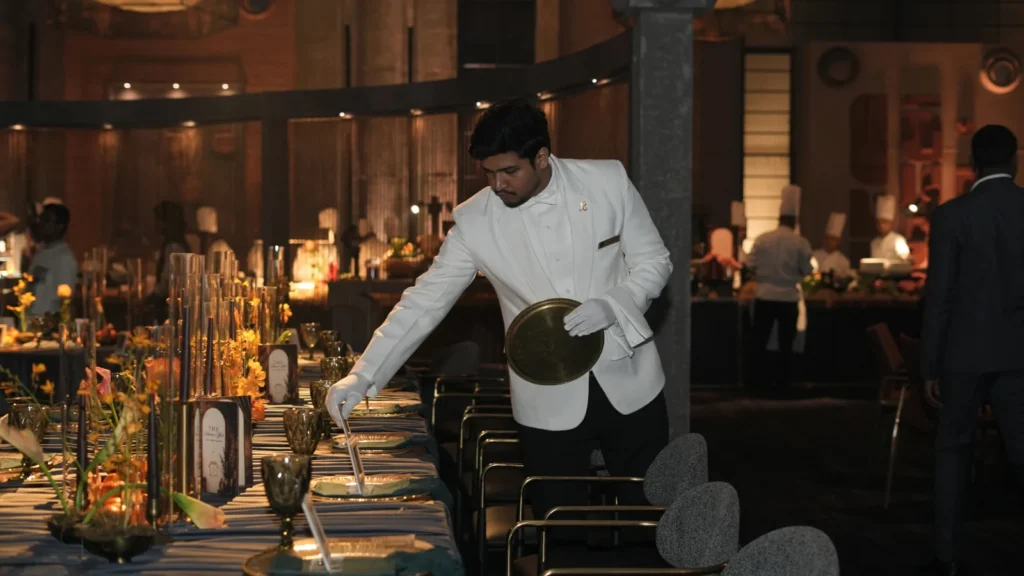
Before a waiter says anything, guests have already seen their uniform, hair, shoes and hands. This isn’t about looks. It’s about cleanliness and care: a pressed shirt, neatly kept hair, clean nails, shoes that have been polished rather than merely worn.
The detail people underestimate is consistency. One waiter in a crisp black waistcoat and another in a slightly faded one, with scuffed shoes, makes the whole team look assembled at the last minute. The service itself may be technically fine, but the visual inconsistency suggests nobody was checking.
Butlerkart treats this as a baseline. Its waiter and steward services page states that staff arrive in clean, well-ironed uniforms with polished shoes and proper grooming, and that dress codes can be customised to suit an event’s theme. That last point matters more at Indian weddings than people realise, where a mehendi, a sangeet and a reception can each call for a different look.
2. Posture: Are They Ready, or Just Standing There?
Guests can tell the difference between staff who are waiting and staff who are ready.
Passive posture looks like slouching, leaning against a buffet counter, hands in pockets, glancing at a phone, or chatting in a cluster near the service door.
Professional posture looks alert but relaxed. The waiter is visible, stands at a sensible distance from guests, and is clearly available without hovering.
Good posture isn’t about standing stiffly like a guard. Guests actually find that uncomfortable. The goal is to look available without looking intrusive, so a guest who needs something knows exactly who to catch, and a guest who doesn’t never feels watched.
3. Where They Look
This is one of the most revealing signals, and one of the least discussed.
An attentive waiter’s eyes are busy. They move between the tables, the service area, the entrance, the half-finished plates and the glasses running low. When a guest glances up, they often find a staff member already looking their way.
A distracted waiter’s eyes are elsewhere: on a phone, on a colleague, on the floor, on nothing in particular.
That’s the difference between being present and being attentive. Plenty of staff are physically present at an event. Fewer are actually watching it.
4. How Fast They Notice Something
Guests don’t time responses with a stopwatch, but they feel it when their glass has been empty for a while, when a used plate sits in front of them through the next conversation, or when they have to wave twice for help.
Professional hospitality leans on anticipation. A good waiter notices the empty water glass and refills it without being asked. They see an elderly guest looking around the room and walk over before she has to get up. They spot that a buffet tray of paneer tikka is running low before the queue notices.
Anticipation, however, is not interruption. A waiter who asks “More water, sir?” in the middle of a toast has noticed the glass but missed the moment. The skill lies in reading the table as well as the glassware: refilling quietly, waiting for a pause, and clearing a plate only when the guest has clearly finished rather than while they’re still holding a piece of roti.
5. How They Move Through a Room
Movement is a signal in its own right. A room full of staff rushing, weaving and brushing past chairs feels chaotic, even if the food is arriving on time.
Professional movement tends to look like this:
-
- Walking briskly, not running.
-
- Carrying trays securely and at a steady height.
-
- Moving around seated guests with care, never reaching across them.
-
- Not blocking entrances, stage steps or photo areas.
-
- Going around conversations rather than through them.
-
- Knowing where to stand when not actively serving.
At a crowded sangeet, with a dance floor, a photographer and children running in every direction, this becomes a real skill. Done well, service almost disappears into the background. Things simply keep arriving and leaving at the right time.
6. How They Approach a Guest
The first few seconds of any interaction set the tone. Guests notice how close a waiter stands, whether they wait for a natural pause, how calm their voice is, whether they make eye contact and whether they actually listen.
Compare a waiter who walks up mid-conversation and says “Yes, what do you need?” with one who steps in at a comfortable distance, waits for a gap, and says, “Excuse me, can I get you anything?” The request is identical. The experience is not.
It’s less about a script and more about manner: understanding the request the first time, confirming it if needed, and responding clearly.
7. What Happens When Something Goes Wrong
Every event has moments that don’t go to plan. A glass tips over. A plate slips. A vegetarian guest receives the wrong starter. A table gets missed during the main course. A guest, tired after a long day, loses patience.
Guests often remember how the situation was handled more vividly than the mistake itself.
Professional handling usually means staying calm, acknowledging the problem, fixing what can be fixed immediately, and escalating to a supervisor where needed. It never means blaming a colleague in front of guests or arguing about whose fault it was.
No staffing company can promise that nothing will go wrong. What trained staff offer is composure when it does, and composure is what keeps a small incident small.
8. How Staff Talk to Each Other
Event organisers often underestimate how much guests overhear. Loud conversations near the buffet, complaints about the shift, someone calling across the room, a waiter pointing at a table, a disagreement near the kitchen door: guests notice all of it.
Internal communication should be discreet, concise, respectful and operational. A quiet word, a small hand signal, a short exchange out of the guests’ line of sight.
Guests should experience the hospitality, not the backstage operation.
9. Team Consistency
One outstanding waiter cannot rescue a visibly inconsistent team. Guests pick up on mismatched uniforms, uneven grooming, some staff being proactive while others stand idle, and two people giving a guest different directions to the same place.
Consistency is what makes an event feel organised. It tells guests that someone briefed the team, set a standard and is making sure it holds.
This is where a professionally managed hospitality team differs from a group of individuals hired separately. Butlerkart’s model is built around that coordination. Clients can combine butlers, waiters and stewards, mixologists and hospitality staff in a single staffing package based on their event type and guest count, and its event coordinators are described as managing staff movements, guest flow and real-time problem-solving on the ground. For multi-day weddings, Butlerkart says it staffs everything from the mehendi and sangeet to the main ceremony and reception with consistent teams across every function, which is exactly the kind of continuity guests pick up on.
10. Whether Staff Know What They’re Doing
Guests don’t expect every waiter to know everything. They do notice uncertainty.
A guest asks, “Where’s the dining area?”
A weak response: “I don’t know. Ask someone else.”
A professional response: “Certainly, it’s just this way.”
Even if a waiter needs to check something, such as whether the Jain food counter is open yet, the guest shouldn’t feel abandoned. “Let me confirm that for you” followed by a prompt answer feels completely different from a shrug.
This kind of confidence comes from preparation: familiarity with the venue, a pre-event briefing, clear roles, known service zones and a basic understanding of the schedule. At a multi-day destination wedding in Udaipur or Goa, knowing when the pheras begin or where the shuttle leaves from is part of the job.
11. How Staff Treat Different Guests
Guests notice how staff treat other guests, too.
Good hospitality adapts. It might mean offering an arm to an elderly relative on uneven lawn, bringing a child-friendly option without being asked, speaking slowly and clearly with an international guest, or patiently guiding someone who is new to the venue.
There is a difference, though, between personalised service and obvious favouritism. VIP guests may have dedicated attention, but if the rest of the room sees three waiters around one table while their own requests go unanswered, it creates discomfort. The aim is for everyone to feel appropriately looked after.
12. The Details Guests May Never Mention
They notice:
-
- Clean cuffs and polished shoes
-
- Straight but relaxed posture
-
- Calm, unhurried movement
-
- An empty glass being spotted
-
- Plates cleared without asking
-
- Staff appearing when needed, and not when they aren’t
-
- Staff who know the venue
-
- Quiet communication between team members
-
- Appropriate eye contact and respectful distance
-
- Matching uniforms across the team
-
- A calm response to a spill
Nobody compliments these one at a time. Together, they create the feeling of a professionally managed event.
13. The “Invisible” Standard of Great Hospitality
There is a paradox in good service: the better it is, the less guests notice the effort behind it.
The waiter shouldn’t become the centre of attention. The service should support the occasion, whether that’s a bride’s family greeting guests or a CEO addressing clients at a product launch.
The goal isn’t for guests to remember every waiter they met. It’s for them to remember how well they were looked after.
14. Why Training Matters More Than a Uniform
A uniform creates visual consistency. Training creates behavioural consistency. Someone can look perfectly professional and still offer poor hospitality.
When evaluating wedding hospitality staff or corporate event staff, look for training that covers guest interaction, service etiquette, tray handling, table and buffet service, food and beverage service, grooming, communication, professional conduct, situational awareness and handling unexpected requests.
According to Butlerkart’s staffing FAQs, every team member is trained in-house in hospitality, grooming, hygiene, guest etiquette and formal service standards before being deployed to an event. Its waiters and stewards are described as trained in hospitality standards, communication and guest handling, and its hospitality staff in silver service, formal etiquette and discreet guest interaction. For anyone planning a luxury wedding or a formal corporate dinner, those are the areas that shape how guests feel.
15. What Butlerkart Brings to the Guest Experience
Butlerkart is a hospitality and event staffing company founded in India in 2014 and based in New Delhi. According to its website, it brings over 15 years of combined industry expertise, has delivered more than 3,656 events and has supported clients in more than 20 countries, with teams covering cities including Delhi, Gurugram, Noida, Mumbai, Udaipur and Jodhpur, as well as international destinations.
Rather than list services, it’s more useful to connect them to the silent signals above:
-
- Grooming and presentation → visual consistency. Clean, well-ironed uniforms and polished shoes mean the team reads as one unit from the moment guests arrive.
-
- Guest handling and assistance → faster response. Staff assigned to help with seating, queries and comfort mean guests don’t have to go looking for someone.
-
- Buffet and table service → fewer interruptions. Replenishing food, clearing plates and keeping stations clean keeps the dining experience flowing without constant back-and-forth.
-
- Tray service and passed snacks → smoother circulation. Starters reach guests where they are, which keeps the mingling going during cocktail hours and sangeet evenings.
-
- Food and beverage serving → attention to timing. Butlerkart highlights presentation, hygiene and timely delivery, the details guests register without thinking about them.
-
- Event coordinators → team-wide consistency. Someone is managing staff movements and guest flow, so individual waiters aren’t left guessing.
You can explore the full scope on Butlerkart’s Waiter & Steward Services page.
16. Why Staffing Should Be Judged on More Than Headcount
“I just need 20 waiters” is one of the most common requests in event planning. Numbers do matter. Butlerkart’s own general guidance is roughly one waiter for every 15 to 20 guests, depending on the style of service. But headcount alone tells you very little about the experience guests will have.
Better questions to ask any event staffing provider include:
-
- How are staff trained?
-
- How is grooming checked and maintained?
-
- Are staff briefed before the event?
-
- Do they understand guest etiquette?
-
- How are roles and service zones assigned?
-
- How is guest assistance handled?
-
- Who coordinates the team on the day?
-
- How are unexpected situations managed?
-
- Have the staff worked this type of event before?
Butlerkart publicly addresses several of these, including in-house training, grooming, experience across weddings, corporate events and private parties, and a point of contact for coordination before and during every booking. For event-specific details such as briefing and role allocation, it’s worth raising them directly when you discuss your requirements.
17. A Client’s Checklist Before Hiring Event Staff
-
- □ Professional grooming standard
-
- □ Clear uniform policy
-
- □ Staff training
-
- □ Event experience
-
- □ Guest-handling etiquette
-
- □ Role allocation
-
- □ Pre-event briefing
-
- □ Service-area knowledge
-
- □ Table and buffet service capability
-
- □ Guest assistance
-
- □ Professional communication
-
- □ Clear staffing plan
-
- □ On-site coordination where required
18. 10 Things Your Guests Notice Without Saying
-
- Grooming: clean, neat and cared for.
-
- Uniform: consistent across the whole team.
-
- Posture: available, not idle.
-
- Eye contact: warm, brief and attentive.
-
- Awareness: spotting needs before they’re voiced.
-
- Movement: calm, careful and never in the way.
-
- Timing: knowing when to step in and when to wait.
-
- Communication: polite with guests, discreet with colleagues.
-
- Response to mistakes: composed, not defensive.
-
- Team consistency: one standard, visible everywhere.
Conclusion: Guests Feel What They Never Say
Guests don’t experience your event through spreadsheets, vendor lists or seating charts. They experience it through small interactions: a drink offered at the right moment, a plate cleared without fuss, a question answered with confidence.
They will probably never say, “Your waiter’s posture was excellent.” But they will feel whether the event was organised, attentive, calm, professional and welcoming.
That’s why professional event staffing is about more than filling a roster. The people representing your event need to understand that every interaction, movement and detail contributes to the guest experience.
If you’re planning a wedding, corporate event, private celebration or luxury gathering, you can discuss your staffing requirements with Butlerkart.
Website: www.butlerkart.com
Instagram: @butler.kart
Frequently Asked Questions
1. What do guests look for in professional waiters?
Mostly things they won’t articulate: a neat appearance, attentiveness, calm movement, polite interaction and quick responses. Together, these create the sense that the event is well managed.
2. Why is waiter grooming important at an event?
Grooming is the first signal guests receive. Clean, consistent uniforms suggest the whole event has been planned with care, while untidy or mismatched staff can make even good service look disorganised.
3. What makes a waiter look professional?
A clean uniform, good posture, attentive eye contact, careful movement and a calm, courteous manner. Professionalism is as much about behaviour as appearance.
4. What should a wedding waiter wear?
Typically a clean, well-fitted formal uniform with polished shoes, matched across the team. Many hosts coordinate the dress code with the event theme. Butlerkart notes that its dress codes can be customised.
5. How should waiters interact with guests?
At a comfortable distance, with a polite greeting, a calm tone and genuine listening. They should wait for a natural pause rather than interrupting conversations.
6. Why is staff training important in hospitality?
Uniforms make a team look consistent, but training makes it behave consistently, covering etiquette, service technique, communication and handling unexpected situations.
7. How should waiters handle difficult situations?
Stay calm, acknowledge the issue, fix what can be fixed and escalate to a supervisor where needed. Never argue with guests or blame colleagues in front of them.
8. Should waiters approach guests proactively?
Yes, but with judgement. Refilling a glass or clearing a finished plate is helpful. Interrupting a speech or a private conversation is not.
9. What is the difference between a waiter and a professional event steward?
The terms often overlap. Waiters generally focus on serving food and drinks, while stewards may also handle guest assistance, buffet management and broader floor support. Butlerkart offers both under its waiter and steward services.
10. How does professional staffing affect guest experience?
It shapes how organised, calm and welcoming an event feels. Many of the impressions guests take home come from their interactions with staff.
11. What should I check before hiring wedding waiters?
Training, grooming standards, uniform policy, experience with weddings, pre-event briefing, role allocation and on-site coordination. The checklist above is a useful starting point.
12. Does Butlerkart provide professional waiter and steward services?
Yes. Butlerkart provides waiters and stewards for weddings, corporate events and private parties, covering food and beverage service, guest assistance, buffet and table service, and tray service with passed snacks.