
Your Buffet Isn’t the Problem: 7 Hidden Staffing Mistakes That Create Long Queues at Weddings
The buffet opened at 8:30 PM.
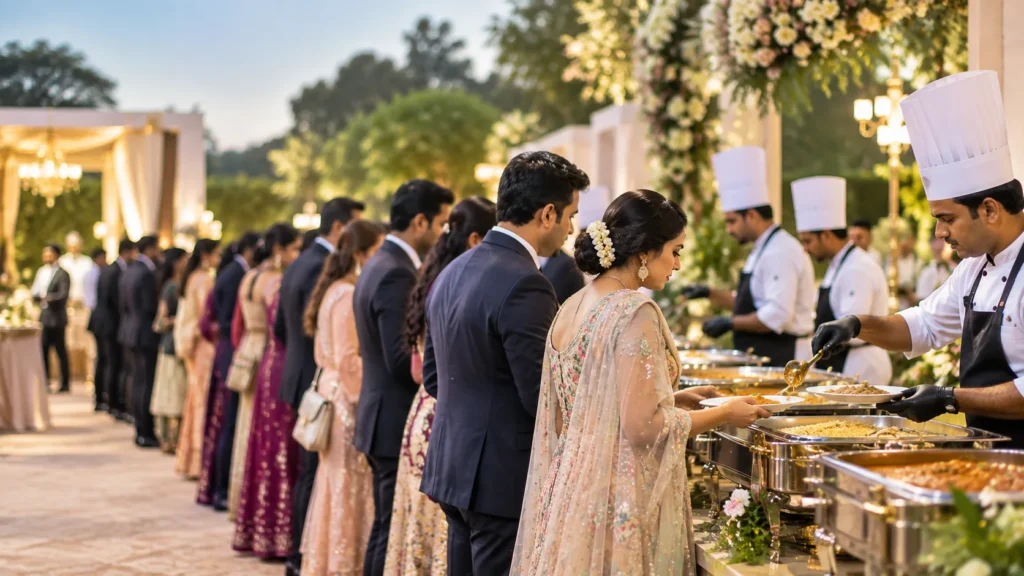
By 8:37, the line had stretched past the first row of dining tables. An uncle was balancing two plates, one for himself and one for his mother waiting near the stage.
The food wasn’t running out. Six counters for 450 guests isn’t small. The kitchen was sending out dal makhani as fast as anyone could eat it.
So why was everyone waiting?
Spend five minutes on the floor and the answers appear. Most of the service team was standing behind the main-course counters. Tables near the buffet were covered in used plates, so served guests stood in the aisle, blocking the line. The paneer tray had run down to the last spoonful, and the counter stopped while a fresh one came out. And nobody noticed that the Chinese counter at the far end had no line at all.
The buffet wasn’t the problem. The staffing plan was.
Why buffet queues are so visible at Indian weddings
Indian weddings pack a lot of demand into a short window. Guest lists run into the hundreds, and people arrive in waves: after the varmala, off the hotel shuttle, once the baraat settles. The same team may be handling a chaat corner, live counters, the main course, welcome drinks and starters.
Add grandparents, small children, VIP family friends and a service team on its third function in two days.
Then someone announces “khana lag gaya hai”, and a few hundred people move at once.
When the line forms, the buffet gets the blame. Sometimes that’s fair. But plenty of weddings with enough food, enough counters and a good caterer still end up with long queues.
So what if the buffet isn’t the problem? Here are seven hidden wedding buffet staffing mistakes, and what to do about each.
Guest flow is a chain
A buffet queue is the visible end of a longer sequence:
Arrival → Entry → Welcome → Food and beverage access → Serving → Seating → Plate and glass clearing → Replenishment → Exit from the service area
If any link slows, guests back up behind it, and the backup usually shows at the buffet even when it started at the tables or the gate. Staffing touches almost every link.
Mistake 1: Staffing by total guest count alone
“500 guests” tells you surprisingly little. Five hundred people drifting in over three hours is a different evening from 500 people converging on dinner within 20–30 minutes of it opening.
Headcount-based plans assume demand is spread evenly. It rarely is. The dinner announcement creates a spike where every counter, table and drinks request peaks together, and 400 guests in a compact hall behave differently from 400 across a lawn. Staff for the average, and the team spends the peak catching up.
Do this instead: Estimate how many guests will be at the food during the busiest half-hour, and staff for that window. The 30-minute wedding rush guide covers the arrival side in detail. When you brief Butlerkart’s waiter and steward team, share the dinner timing and arrival pattern, not just the guest count.
Mistake 2: Putting staff in the wrong places
A wedding can have the right number of staff and still position them badly:
- Six stewards behind a counter that needs two
- Nobody at the entrance when a shuttle unloads
- No one circulating with drinks, so guests queue at the bar
- No one telling guests the South Indian counter across the lawn is empty
Each of these pushes more people toward the same spot. Staff placement can matter as much as staff count.
Do this instead: Walk the guest journey on the venue layout and place people where guests will be at each stage. Butlerkart lists guest assistance, buffet service and tray service as separate parts of its waiter and steward services, which makes it easier to plan each role around a part of the venue.
Mistake 3: Nobody is assigned to clearing
This is the most underestimated cause of a buffet queue at a wedding.
A family of five finishes eating. Their plates stay on the table. They stand to chat, but the table still looks taken, so the next family, plates in hand, can’t sit. They hover near the buffet. Others do the same. Soon the space around the counters is full of people who’ve already been served, and the line can’t move.
The effects stack up:
- Tables are unavailable even though nobody is using them
- New arrivals can’t find seats, delay going to the buffet, then all go at once
- Staff clear only when someone complains, pulling them off other work
- The dining area looks more crowded than it is
Clearing isn’t housekeeping. Free tables keep the line moving.
Do this instead: Give clearing a named owner before dinner starts: stewards assigned to table sections at a large wedding, or part of each steward’s zone at a smaller one. Plate clearing is part of how Butlerkart describes its buffet and table service.
Mistake 4: Replenishing only when the tray is empty
The mutton rogan josh starts running low. Guests notice, and more people head to that counter. By the time staff react, the tray is empty, the counter pauses for a fresh one, and the line grows.
The food existed. The delay was in noticing and passing on the message.
Two teams are involved. The caterer’s kitchen decides what gets cooked and when; service staff see what’s happening at the counters. When nobody watches levels or knows who to tell, replenishment becomes a scramble.
Do this instead: Agree on a trigger in advance (for example, flag a dish at about a third full) and on who tells the caterer. Watch the two or three dishes most likely to run out. Butlerkart’s stewards handle replenishment at the counters, while cooking and quantities stay with your caterer, so agree that handover before service.
Mistake 5: Everyone is serving, but nobody is watching the flow
You can have 30 waiters and nobody looking at the whole floor.
Twenty minutes into dinner, the tandoor counter has a line fifteen deep. The pasta counter beside it is nearly empty. Staff at both keep doing what they were told, and guests keep joining the long line because that’s where everyone else is.
Someone watching the floor would spot it in a minute, point guests to the pasta counter and move a steward across to the tandoor. That’s the job of a floor supervisor or service coordinator, ideally one clearly named person.
Do this instead: Decide before the event who runs service on the floor and how they’ll communicate with staff, the caterer and the planner. For larger events, Butlerkart’s event staffing provides event coordinators whose stated role covers guest flow, staff movements and real-time problem-solving.
Mistake 6: Planning drinks, starters and dinner as separate jobs
On paper, these are three stages. In practice, they overlap.
Dinner opens, but many guests still hold welcome drinks, a late wave is at the gate and starter trays are still going round. Cocktail tables need clearing, and someone’s grandmother wants to know where the family is sitting.
If the bar, starters and buffet teams were planned separately, this handover is where things break. Either the buffet opens short-handed because staff are still on trays, or starters stop abruptly and everyone rushes the counters.
Do this instead: Plan one guest journey. Decide when tray service winds down, who moves to buffet support, and who stays on drinks and clearing. Tapering starters as the first counters open spreads demand instead of stacking it. Butlerkart clients often combine waiters, stewards and mixologists for one event, keeping those handovers in one plan.
Mistake 7: Forgetting guests and zones that need more attention
Some guests need more help, and that’s normal. Elderly relatives may not manage a queue and a full plate. Guests with limited mobility may need food brought to them. Parents of small children leave the line twice. VIPs may have separate seating with table service. International guests may not know what each counter serves.
The venue adds its own layer: a separate VIP terrace, outdoor seating far from the counters, two floors, stations on opposite sides of a lawn.
All of this takes service time. If it isn’t planned for, staff get pulled away one request at a time, and the queue grows while they’re gone.
Do this instead: Staff for service complexity, not just headcount. Assign specific people to elders’ tables and VIP areas, and keep guest assistance separate from counter duty.
The real reason buffet queues form
A queue forms when more guests reach a service point than it can handle at that moment. The fix depends on the kind of problem:
- Capacity problem: too few counters or too little food. A bigger buffet helps.
- Flow problem: the setup is fine, but something around it is slow, such as uncleared tables, late replenishment or staff in the wrong place. Better staffing and positioning help; more counters won’t.
Many weddings have both. Flow problems are just easier to miss, because the line still forms in front of the buffet.
How to diagnose a wedding buffet before the event
Sit down with your planner, caterer and staffing provider and answer these:
- How many guests are expected?
- How many will reach dinner in the peak 30 minutes?
- How many buffet stations are there?
- Which will be most popular?
- How far apart are the stations?
- Who is responsible for table clearing?
- Who monitors dish levels and tells the caterer?
- Who handles guest questions?
- Where will welcome drinks be served, and does that block the way to dinner?
- Will starters be tray-passed, and when will that stop?
- Are VIP guests seated separately?
- Which elderly guests will need food brought to them?
- Is there an indoor/outdoor split?
- Who coordinates staff deployment during the event?
If you can’t put a name against questions 6, 7, 8 and 14, that’s probably where your queue will start.
How many staff do you actually need?
No single number fits every wedding. It depends on guest count, peak arrival, buffet or plated service, food and beverage stations, tray-passed starters, venue size and floors, guest demographics, VIP needs, event duration and the service level you expect.
As a starting point, Butlerkart’s waiter and steward page says that generally about 1 waiter for every 15–20 guests is recommended, depending on guest count and service type. That’s Butlerkart’s own guideline, not a universal industry rule. Dividing guest count by 20 and by 15 gives these illustrative starting ranges:
| Guests | Starting range |
|---|---|
| 100 | about 5–7 staff |
| 200 | about 10–14 staff |
| 300 | about 15–20 staff |
| 500 | about 25–34 staff |
These aren’t requirements. Spread-out counters, live stations, passed starters and heavy clearing may push you to the upper end or beyond during the peak. A compact venue with a staggered crowd may run well at the lower end. See also how many waiters you need for 100 guests.
Why Butlerkart should be part of the staffing conversation
Most of the mistakes above are about people, not food. Butlerkart is an event and hospitality staffing company based in New Delhi. Its website cites over 15 years of expertise in luxury hospitality and event staffing, 3,656 events across India and worldwide, and teams that have supported clients in more than 20 countries.
Its waiter and steward services for weddings and events cover:
- Food and beverage serving, with attention to presentation, hygiene and timely delivery
- Guest handling and assistance, including seating, queries and comfort
- Buffet and table service, including replenishment, plate clearing and cleanliness
- Tray service and passed snacks
Staff are described as trained in hospitality etiquette, grooming and guest handling, and arrive in formal uniforms that can match your dress code. Larger weddings can add event coordinators or butler services.
On scope: Butlerkart supplies the guest-facing service team. Your caterer still runs the kitchen, and your planner and venue still own the layout. The staffing partner makes sure the service team is the right size, in the right roles and in the right places.
Hiring more waiters vs planning hospitality staff
Ten extra people standing where everyone else is standing won’t shorten the line. Planning hospitality staff means deciding:
- Roles and responsibilities: who serves, clears, handles drinks and looks after elders, and which tables each person owns
- Positions and timing: where each person stands at arrival, dinner and dessert, and when trays hand over to the buffet
- Guest interaction and presentation: uniformed staff guests can find, who walk a guest to a quieter counter rather than point
- Coordination and adaptability: someone who can move staff when the baraat runs late or rain pushes everyone indoors
That’s the difference between a headcount and a service plan. Butlerkart builds staffing packages around event type and guest count. Whichever provider you use, ask them to walk you through these points.
Buffet queue red-flag checklist
- All staff are concentrated around the buffet
- No one is monitoring tables
- Guests are arriving faster than service staff can respond
- Popular dishes repeatedly run low
- No one is assigned to clearing
- Guests don’t know where to go
- Staff are waiting for instructions
- VIP or elderly guests need help, but nobody is assigned to them
- Multiple service zones are running without coordination
If several of these are true, on the night or in your plan, the buffet probably isn’t the main problem.
How to reduce buffet queues before the wedding
- Calculate peak volume. Ask the families when most guests will really arrive.
- Staff for the peak, using the 1:15–20 guideline as a check.
- Assign roles: counter service, clearing, drinks, trays and guest assistance.
- Mark positions on the layout for arrivals and for dinner.
- Keep clearing continuous, not in occasional sweeps.
- Put experienced staff on the busiest counters.
- Set a replenishment trigger with the caterer.
- Separate guest assistance from counter duty.
- Brief staff before service on the layout, VIPs, menu and timeline.
- Name one person to watch the flow and move staff as needed.
Before the first queue forms
Go back to 8:37 PM. There was enough food, enough counters and a caterer doing its job. What was missing was clearing, timely replenishment, staff where the guests were, and someone watching the floor.
The buffet wasn’t the problem.
If your guest list looks manageable on paper but dinner will begin with several hundred people moving toward the same service area, the staffing plan deserves as much attention as the buffet menu. Share your guest count, venue setup, service format and event schedule with Butlerkart’s waiter and steward team, and work out the staffing requirement before the first queue forms.
Website: www.butlerkart.com
Instagram: @butler.kart
Frequently asked questions
1. Why do wedding buffets have long queues?
Usually because many guests reach the food at once and something around the buffet slows them down, such as uncleared tables, late replenishment or poorly placed staff.
2. How many waiters do I need for a wedding buffet?
Start with Butlerkart’s guideline of about one waiter per 15–20 guests, then adjust for peak arrival, stations and layout.
3. What is the waiter-to-guest ratio for a wedding?
There’s no universal ratio. Butlerkart’s 1:15–20 guideline is a starting point, not a rule.
4. How many waiters do I need for 100 guests?
About 5–7 as a starting point.
5. How many waiters do I need for 200 guests?
About 10–14, more for a large lawn or several counters.
6. How many waiters do I need for 500 guests?
About 25–34 to start. Peak timing and supervision matter as much as the ratio.
7. Does adding more buffet counters reduce queues?
Only if the problem is capacity. If it’s uncleared tables or late replenishment, more counters spread the same problem.
8. Who should manage table clearing at a wedding?
Named stewards assigned to table sections, agreed in advance.
9. Do I need separate staff for drinks and buffet service?
At most mid-size and large weddings, yes, at least during the peak.
10. What does a wedding steward do?
Serves food and drinks, manages buffet counters, replenishes dishes, clears plates and assists guests.
11. How can professional staffing reduce buffet queues?
By staffing for the peak, assigning clear roles, positioning staff along the guest journey and coordinating the floor.
12. Does Butlerkart provide waiter and steward services for weddings?
Yes. Its waiter and steward services cover weddings, including buffet, table and tray service and guest assistance.