
The 30-Minute Wedding Rush: How Many Waiters Do You Need When Everyone Arrives at Once?
6:52 PM. The lawn is lit and the buffet counters are dressed. Forty glasses of welcome mocktail sit in neat rows at the bar. The service team is in position, and everything looks calm.
7:04 PM. The shuttle from the hotel has just unloaded, the parking has filled in one wave, and about two hundred guests are walking toward the entrance within the same few minutes.
By 7:15, the first tray of drinks is empty before it has crossed the lawn. An elderly relative near the stage is looking for a chair with a backrest. Someone wants directions to the washroom, and someone else wants to know where the family is sitting. The tikka counter has a queue, but the passed starters haven’t reached the far corner of the tent. Used glasses are piling up on every high table. A group of the family’s most important guests has arrived, and nobody has noticed them yet.
Nothing has actually gone wrong. There just aren’t enough trained hands in the right places at the same moment.
That’s the 30-minute wedding rush. It’s also why the question “how many waiters do you need for a wedding?” doesn’t have a one-line answer. A ratio helps, but the better answer comes from asking when your guests will need service, and how many of them will need it at the same time.
Why the first 30 minutes can be harder than the next three hours
Every wedding has a peak-service window: a short period when demand jumps far above the evening’s average.
Take a 300-guest reception. For most of the night, perhaps 40 or 50 guests are actively asking for something at any given moment. One wants a refill, a table needs clearing, a guest is looking for the dessert counter. A well-staffed team handles that comfortably.
Now suppose 200 of those guests arrive within 25 minutes. That’s roughly seven or eight people coming through the entrance every minute. Each one expects a welcome drink, some expect help finding a seat, and many will reach for a starter within minutes of arriving. A tray carries perhaps a dozen glasses, so at the entrance it can be empty in under two minutes, and then it has to go back to the bar and return full.
All of this happens at once:
- Beverage service at the entrance and across the lawn
- Starters that need to reach every corner, not just the area near the kitchen
- Guests asking for directions in an unfamiliar venue
- Seating help for elderly guests and families with children
- Glasses and plates that need clearing before tables look cluttered
- Buffet counters opening while arrivals are still coming in
Staff numbers that look generous at 9:30 PM can feel thin at 7:10 PM.
How many waiters do you need for a wedding?
A useful place to start is the guidance on Butlerkart’s Waiter & Steward Services page. It says that, generally, around one waiter for every 15–20 guests is recommended for efficient service, and that the actual requirement depends on guest count and service type.
That second part matters as much as the ratio. Treat 1:15–20 as a starting point for the conversation, not as a universal industry rule. The number should move up or down depending on:
- Buffet, plated or mixed service
- Whether starters are tray-passed
- How many service areas you have (bar, lawn, dining, lounge)
- How your guests are likely to arrive
- Venue size, number of floors, and indoor and outdoor spaces
- VIP and family hospitality requirements
- Event duration and staff shifts
- Whether more than one function is running at the same time
A practical wedding staffing table
The ranges below apply Butlerkart’s stated 1:15–20 guideline to common guest counts. To get them, divide the guest count by 20 for the lower number and by 15 for the higher one, rounding up. These are illustrative planning ranges, not fixed requirements. Your actual plan should be built after the staffing provider understands your event.
| Guest count | Starting range (at 1:15–20) | When you may need more |
|---|---|---|
| 50 | 3–4 staff | Plated courses, a separate bar area, several senior guests |
| 100 | 5–7 staff | Most guests arriving together, tray-passed starters |
| 150 | 8–10 staff | Indoor and outdoor areas, a separate welcome zone |
| 200 | 10–14 staff | Buffet plus passed snacks, a large lawn |
| 300 | 15–20 staff | A 30-minute arrival peak, multiple food counters |
| 500 | 25–34 staff | Multiple floors, a large VIP group, parallel service zones |
| 750+ | 38–50+ staff | Multiple functions, destination logistics, long service hours |
The table can go down as well as up. An intimate buffet dinner where guests arrive gradually may run well at the lower end. A cocktail-heavy reception with passed starters and a rush at the gate may need more than the upper figure during the peak.
The biggest mistake: staffing only for the average
Here’s the trap. A family plans for 300 guests over four hours. That averages to about 75 arrivals and service requests per hour, which sounds manageable.
But if 200 of those guests arrive in the first 30 minutes, the arrival pace during that window is about 400 guests per hour, more than five times the evening’s average. Service demand doesn’t spread itself evenly across the night. It bunches up.
Average demand is not the same as peak demand.
If you staff for the average, your team spends the peak catching up. Guests notice empty trays, full tables and long queues, and first impressions form in exactly those minutes. If you staff for the peak, the team is ahead of the guests when it matters. Later in the evening, experienced staff move naturally into clearing, refills, dessert service and farewells.
What type of service are you providing?
The service format changes where your staff need to be and how busy they are.
Buffet service. Buffets look light on staff, but they aren’t. Someone has to replenish counters, keep serving areas clean, help guests who can’t carry a plate and a drink together, collect used plates and clear tables. Butlerkart describes this work directly: managing buffet counters, food replenishment, plate clearing and maintaining cleanliness.
Plated or table service. Here, the pressure is timing. Every table in a section needs to be served at roughly the same moment, and then cleared together before the next course. Coordination matters as much as headcount.
Tray-passed starters. Circulation is the job. Trays have to reach the guests standing at the far edges, not just the ones near the kitchen door, and each tray needs refilling. Coverage is harder than it looks on a large lawn.
Welcome drinks. This is your first contact with every guest, and it happens at the busiest moment of the night. Welcome drinks need dedicated entrance coverage and a steady supply of full trays coming from the bar.
Mixed service. Most Indian weddings combine all of these: welcome drinks at the gate, passed starters on the lawn, live counters, a buffet dinner and table service for family elders. Each format needs its own share of the team, all at once.
Why Indian weddings make staffing more complicated
Indian weddings aren’t difficult because of any single factor. They’re complex because many factors stack up together.
Guest lists are often large and span three or four generations, each with different needs. Guests may come from the ceremony, straight from the airport, or on hotel shuttles, so arrivals come in waves rather than a trickle. Family members and VIP guests may need discreet, dedicated attention. Destination weddings add hotel coordination and venues that most guests have never seen before. There may be separate bars, lounges, dining areas and children’s zones. And a wedding weekend can mean a haldi in the morning, a mehendi in the afternoon and a sangeet at night, each with its own guest flow.
Then there are last-minute changes: a delayed baraat, a sudden shower that moves everyone indoors, or 40 more guests than the final list. A staffing plan needs enough slack, and enough experience on the ground, to absorb these changes.
What should your waiters actually be doing?
Having enough people is only half the answer. What those people are trained to do matters just as much. During a busy wedding, professional service staff may be:
- Serving food and beverages with attention to presentation and hygiene
- Running tray service and passing starters across all guest areas
- Managing buffet counters and replenishment
- Providing table service and clearing plates and glasses
- Helping guests with seating and answering their questions
- Keeping service areas clean throughout the event
- Responding politely to requests, including the unusual ones
- Coordinating with the planner, caterer and venue team
Ten untrained people standing near the bar don’t do much for the 7:10 PM rush. Ten trained stewards who know their zones can handle it.
Why professional wedding staffing matters
Professional event staffing isn’t about putting more people in uniforms. It’s about discipline under pressure.
A trained waiter knows how to carry a full tray through a crowd, and when to offer something to a guest and when to step back. They know how to spot an elderly guest who needs a chair before the guest has to ask. They arrive on time, groomed and briefed, and they take direction from a supervisor without fuss. They also understand that a buffet, a plated dinner and a cocktail hour each call for a different rhythm.
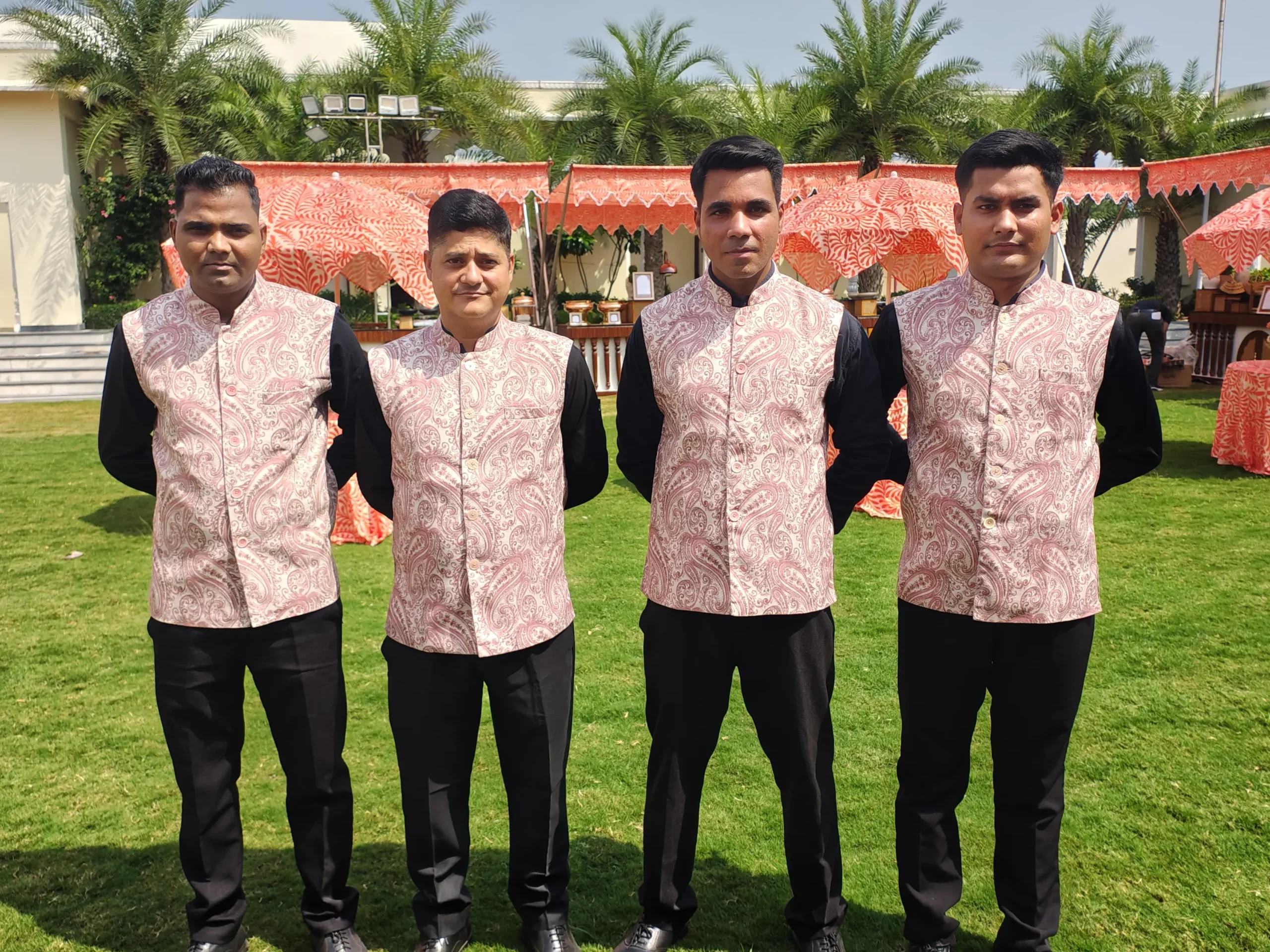
Butlerkart’s waiter and steward page describes its team in these terms: professionally trained in hospitality etiquette, communication and guest handling. It also describes the team as well-groomed, in clean, formal uniforms with polished shoes, with the option to customise dress codes to the event theme. The listed services cover food and beverage service, guest handling and assistance, buffet and table service, and tray service with passed snacks. Those services line up closely with the work that piles up during a wedding rush.
Why Butlerkart is relevant when the 30-minute rush hits
Look back at the 7:04 PM scene. The problems were welcome drinks running out, starters not reaching far corners, cluttered tables, lost guests, elderly relatives without seats and VIPs nobody noticed. Each one maps to a service Butlerkart already lists:
- Tray service and passing snacks for drinks and starters across the venue
- Guest handling and assistance for seating, questions and comfort
- Buffet and table service for replenishment, plate clearing and cleanliness
- Food and beverage service with attention to timely delivery
The team is described as experienced across weddings, corporate events, private parties and farmhouse functions, and Butlerkart lists service across cities including Delhi, Gurgaon, Noida, Mumbai, Udaipur, Jodhpur, Ahmedabad, Mussoorie, Jammu & Kashmir and Jamnagar. The company’s website describes over 15 years of expertise in luxury hospitality and event staffing, and teams that have supported high-profile clients in more than 20 countries.
For larger events, Butlerkart also offers Event Staffing through event coordinators who manage guest flow, staff movement and on-ground problem-solving. That kind of coordination is what turns a group of waiters into a team during the peak. If your wedding needs more than service staff, the same brand offers Butler Services, Mixologist Services and Host Services for entrance welcomes.
The questions to ask before booking wedding waiters
Before you confirm any wedding waiter service, ask these questions. The answers will tell you more than a price quote.
- How many staff will actually be on-site? Get the number of people who will be present, not the number booked on paper.
- What guest-to-staff ratio are you using, and why? A good provider can explain the reasoning behind the number.
- How does the plan change during peak arrival? Ask where each person will be at 7:10 PM, not just at 9:00 PM.
- Is there a supervisor or coordinator on-site? Someone needs to redeploy staff when the rush moves from the gate to the buffet.
- What exactly is included? Tray service, buffet management, table clearing, guest assistance: get it in writing.
Follow-up questions worth asking:
- Are the staff trained in hospitality etiquette and guest handling?
- What will they wear, and can the dress code match the event?
- Can the numbers change if your guest count or flow changes?
- Will they coordinate with your planner and caterer?
- How far in advance should you book? Butlerkart’s site suggests 3–5 days, especially for weekends, with last-minute requests handled depending on availability. Book much earlier during the wedding season.
A simple way to plan your staffing
This is a planning framework, not a mathematical formula:
Step 1: Count your total guests.
Step 2: Estimate how many will arrive during the busiest 30 minutes. Hotel shuttles, a baraat and a fixed ceremony end time all create arrival waves.
Step 3: Identify your service style: buffet, plated, passed starters, or a mix.
Step 4: Count your service zones, such as the entrance, bar, lawn, dining area and lounge.
Step 5: Note how many VIP, elderly or family guests need dedicated attention.
Step 6: Add supervision and coordination.
Step 7: Take all of this to your staffing provider and build the final plan together.
Steps 2 and 4 are where most plans change. A 200-guest wedding with one lawn and a staggered arrival is a very different job from a 200-guest wedding with three zones and a single shuttle drop.
When should you hire more staff?
Consider going beyond the starting range when:
- A large share of guests will arrive together
- The venue is large or spread across multiple floors
- You have several dining or bar areas
- Starters are tray-passed throughout the evening
- The meal is plated
- There is a large VIP or family group to look after
- It’s a destination wedding with unfamiliar venues
- Several functions overlap
- You want a high level of personalised guest attention
Butlerkart: from waiters to event hospitality
The goal of wedding hospitality staff was never just to move food from the kitchen to the table. The goal is to make sure every guest feels welcomed, assisted, served and comfortable, and gets guided whenever they need it.
That’s what the 30-minute rush tests. When staffing is planned well, guests never see the pressure behind the event. They get a cold drink at the gate, a starter within minutes, and a clean table to put their glass on. Someone offers Nani ji a chair before she asks. None of that feels like logistics to the guest, and that’s the point.
So, how many waiters do you really need?
Go back to 7:04 PM, with two hundred guests at the gate and the starters just leaving the kitchen.
The question isn’t only “How many waiters do I need?” A better question is “How much service demand will hit my team at the same time?”
The answer comes from putting these together:
guest count + peak arrival volume + service style + venue layout + guest expectations + event complexity
If your wedding is approaching and you already know that several hundred guests may arrive within the same half-hour, plan the staffing before the first guest walks through the door. Butlerkart can help you work through your guest count, service format and event requirements and build a staffing plan around them. Start with its Waiter & Steward Services, or visit www.butlerkart.com to share your event details. You can also see their event work on Instagram at @butler.kart.
Frequently asked questions
1. How many waiters do I need for 100 wedding guests?
Using Butlerkart’s general guideline of one waiter per 15–20 guests, roughly 5–7 staff is a sensible starting point. Plan for more if most guests arrive together or if you’re serving passed starters and plated courses.
2. How many waiters are needed for 200 wedding guests?
Around 10–14 staff as a starting range. A large lawn, multiple counters or a sharp arrival peak can push that higher.
3. How many waiters do I need for 300 guests?
Approximately 15–20 staff as a starting point. If 200 or more of those guests arrive within 30 minutes, plan specifically for that window.
4. What is the ideal waiter-to-guest ratio for a wedding?
Butlerkart states that one waiter for every 15–20 guests is generally recommended. Treat it as a baseline to adjust for service style, venue and guest flow.
5. Do I need more waiters if all guests arrive at the same time?
Often, yes, at least during the peak. A simultaneous arrival concentrates welcome drinks, starters, seating help and clearing into one short window.
6. How many waiters do I need for buffet service?
Start from the general ratio, then account for counter replenishment, plate clearing, table upkeep and guest assistance. Buffets still need a lot of floor staff.
7. How many waiters do I need for plated dinner service?
Plated service usually leans toward the higher end of the range, because tables in a section need to be served and cleared at the same time.
8. What is the difference between a waiter and a steward?
In Indian event staffing, the terms often overlap. “Waiter” usually suggests food and beverage service, while “steward” is commonly used for service staff who also handle floor duties such as clearing, buffet upkeep and guest assistance. It’s more useful to confirm which duties each person will cover.
9. How much does wedding waiter service cost?
According to Butlerkart, pricing depends on staff type, event duration, number of hours and city, with customised packages shared after understanding your event.
10. Does Butlerkart provide wedding waiter and steward services?
Yes. Its Waiter & Steward Services cover weddings, corporate events and private parties.
11. Can Butlerkart provide staff for large weddings?
Butlerkart’s website describes supporting events from intimate celebrations to large-scale international events, including destination weddings. Share your guest count and dates to confirm availability.
12. Does Butlerkart provide tray service and buffet service?
Yes. Tray service with passed snacks, and buffet and table service, are both listed among its waiter and steward services.